छोटे परदे पर ‘बालिका वधु’ में आनंदी के नाम से मशहूर हुईं प्रत्यूषा बनर्जी…
Bollywood Dopplegangers Who Made It Into Bollywood Because They Look Like Top Actors.
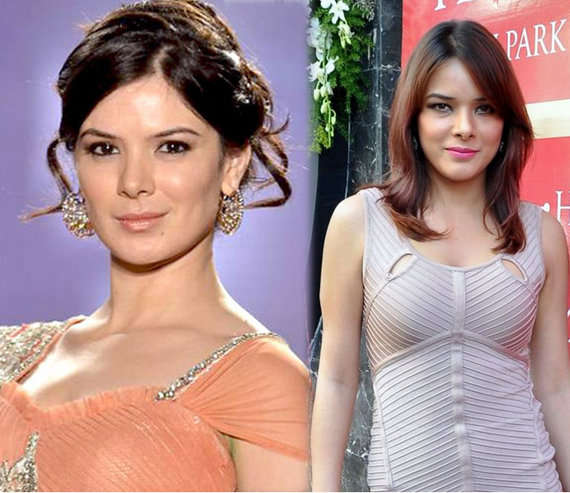
Urvashi made her debut in the movie ‘Naquaab’. She looks a lot like Udita Goswami, wjo debuted in the movie ‘Paap’. The both had short career in Bollywood and are now leading a life of domesticity.
[ads1]
Source: Daily Bhaskar
The Doppelgänger Trap: Bollywood’s Look-Alikes Who Got a Foot in the Door—But Couldn’t Shake the Shadow
In the glittering, star-obsessed world of Bollywood, a new face breaking into the industry is a momentous event. But what if that new face isn’t just talented or beautiful, but an almost identical replica of an already established superstar? For decades, the phenomenon of the ‘celebrity look-alike’ has served as a direct, albeit fraught, entry ticket into the coveted film fraternity. It is a dual-edged sword: an irresistible hook for public curiosity and a potential career curse.
This article explores the stories of actors and actresses who were launched into Bollywood because they looked like a top star—from the scandalous casting moves of the early 2000s to the niche roles and personal identity struggles that followed. Their journeys reveal a universal truth: resemblance might open the door, but genuine stardom demands an identity all your own.
The Uncanny Entry Ticket: Bollywood’s Infamous Look-Alike Launches
The history of the Bollywood doppelgänger making a cinematic debut is littered with names whose uncanny resemblance to a superstar was the very first line of their filmography. This strategy, often employed by powerful producers or directors, is a guaranteed headline-grabber, playing directly into the audience’s fascination with clones.
1. The Aishwarya Rai Doppelgänger: Sneha Ullal
One of the most talked-about launches in this category was that of Sneha Ullal, who debuted opposite Salman Khan in the 2005 film, Lucky: No Time for Love.
- The Uncanny Resemblance: Sneha possessed a striking likeness to the reigning queen of beauty, Aishwarya Rai Bachchan, particularly her light eyes and innocent face.
- The Controversial Context: The launch was widely perceived by the media and public as a move by Salman Khan, Aishwarya Rai’s ex-boyfriend, to introduce someone who looked like her, turning the debut into a major media spectacle.
- The Aftermath: While the resemblance offered an immediate spotlight, it proved to be an impossible shadow to escape. Sneha herself later stated in an interview that the extensive comparison was part of a “PR strategy” which ultimately forced a narrative around her that she struggled to break away from. Finding roles in Bollywood where her appearance wasn’t the sole focus became a challenge. She eventually shifted her focus to the South Indian film industries, particularly Tollywood, where she found independent success and an identity away from the constant, suffocating comparisons.
2. The Katrina Kaif ‘Clone’: Zareen Khan
A similar narrative unfolded with Zareen Khan, who made her debut in another Salman Khan film, Veer (2010).
- The Comparison: Zareen was immediately and relentlessly dubbed a Katrina Kaif look-alike, a label that followed her throughout her career.
- The Career Setback: Zareen has openly discussed how this very comparison, which initially felt like a compliment, eventually became the “biggest hindrance” to her career. She explained that being seen as a “duplicate” in the industry meant filmmakers were hesitant to cast her, making it nearly impossible to establish her own individuality.
- The Personal Toll: The constant scrutiny and being labelled a ‘clone’ resulted in immense mental pressure, with Zareen admitting that she was sometimes “scared to step out of my house” and that critics “saw me as a failure.” This is a stark illustration of how the easy ‘look-alike’ entry ticket can quickly morph into a devastating career trap, stifling the development of a unique artistic persona.
The Double-Act: When Resemblance is the Perfect Job Description
While the curse of the doppelgänger often plagues actresses striving for an independent lead status, the uncanny resemblance of a male actor has, on occasion, served as a unique and invaluable casting asset for specific roles. In these rare instances, the similarity is the primary, celebrated qualification.
1. Najeem Khan: The Young Salman Khan
The film Bajrangi Bhaijaan (2015) provided a perfect, literal application of the doppelgänger phenomenon.
- The Perfect Role: Afghan-born model and actor Najeem Khan, who bore a striking resemblance to a younger Salman Khan, was selected for the coveted role of the superstar’s younger self in the film.
- A Dream Come True: For a struggling actor, this was an almost unimaginable break—a direct launch onto a major set alongside his idol, all thanks to his genetics. The makers of the film were specifically looking for an actor who looked like the star to portray the younger version of the protagonist, Pavan Kumar Chaturvedi.
- Leveraging the Look: Najeem has continued to leverage his appearance by working as a body double for Salman Khan in several other films, including Tiger Zinda Hai and Tubelight, carving out a highly specialized niche career within the industry.
2. Sonu Sood: The Reflection of Young Bachchan
Unlike the actresses who faced derision, some male actors have been able to successfully graduate from the comparison to forge massive independent careers, where the resemblance is simply a flattering note on their journey.
- The Comparison: Actor Sonu Sood, now a major figure in both Bollywood and South Indian cinema, was often noted to share features with a young Amitabh Bachchan.
- The Casting Advantage: His resemblance reportedly helped him land the key role of Abhishek Bachchan’s elder brother in the critically acclaimed film Yuva, which explicitly played on the Bachchan family connection, offering an undeniable, if subtle, nod to the legend.
- Independent Success: Sonu Sood’s career, however, is a model example of overcoming the shadow. His success across various language industries, coupled with his recent philanthropic work, has given him a unique identity far removed from the comparison, transforming a superficial likeness into a fleeting footnote in a distinguished career.
The Historical Precedent: The ‘Junior’ Stars of Yesteryear
The practice of casting look-alikes is not a new phenomenon invented by modern Bollywood; it has deep roots in Indian cinema, particularly during the 1970s and 1980s. In those decades, the popularity of a superstar was so immense that entire low-budget films were made using actors who were direct impersonators or “Juniors.”
- The Original Duplicates: Films like Nasbandi (1978) and 5 Rifles (1974) explicitly featured actors like Anitav Bachchan (a look-alike of Amitabh Bachchan) and Rakesh Khanna (a look-alike of Rajesh Khanna) in leading roles.
- The Parallel Industry: These actors capitalized on the public fascination, often mimicking the mannerisms, hairstyles, and dialogue delivery of the originals, essentially creating a parallel, niche industry of ‘duplicate’ cinema that catered to regions or audiences unable to access the genuine stars. While most of these ‘junior’ careers did not last beyond the initial novelty, they laid the foundation for the look-alike’s path to an industry entry.
The Modern Look-Alike Economy: From Film Sets to Social Media Stardom
In the digital age, the doppelgänger phenomenon has evolved, creating a new, highly lucrative career path entirely separate from the mainstream Bollywood studio system.
The advent of social media platforms like Instagram and TikTok has allowed look-alikes to bypass the traditional industry gatekeepers. Today, an actor does not need a film launch to achieve national fame; they only need a viral video.
- The Ibrahim Qadri Phenomenon: Perhaps the most successful example in recent times is Ibrahim Qadri, the look-alike of Shah Rukh Khan. Qadri has amassed a massive following online by meticulously replicating SRK’s signature looks and mannerisms.
- A New Professional Niche: Qadri has successfully parlayed his resemblance into a professional career as a celebrity impersonator and entertainer, reportedly charging significant fees for appearances at private events, weddings, and commercials across the globe. This form of success, though outside of mainstream lead roles, shows that the likeness itself is a valuable, monetizable commodity.
- The Burden of the Image: Interestingly, Qadri, despite being a lifelong fan, stated that he does not want to meet Shah Rukh Khan in person, believing that to meet one’s hero might “end the craze” and the “josh” (excitement) that fuels his art. This choice highlights a key psychological aspect of the doppelgänger’s career: the maintenance of the fantasy is paramount to their professional success.
The Curse of the Copy: The Struggle for a Singular Identity
The tragic irony of the Bollywood doppelgänger is that the very feature that provides the easy entry—their striking resemblance—is often the same one that prevents true, long-term stardom.
As Zareen Khan stated, “The people of this industry didn’t give me a chance to prove my individuality.” A filmmaker’s first thought is that the audience will be constantly looking for the established star in the newcomer, which ultimately shifts the focus away from the new actor’s talent and persona.
The audience, too, holds the look-alike to an unfair standard: they are expected to possess the original star’s charisma, acting chops, and even box-office success. When they inevitably fall short of this impossible ideal, the judgment is harsh and immediate. Sneha Ullal’s shift to the South Indian industry, where she was initially seen without the Aishwarya Rai baggage, is perhaps the clearest evidence that to succeed, the look-alike must find a space where their talent, not their twin-like face, is the primary narrative.
In the end, while the Bollywood doppelgänger phenomenon is an endlessly fascinating chapter in cinema history, it serves as a powerful cautionary tale: a door opened by resemblance is not a path to individual identity. To move from being a mere replica to a singular star, one must not only possess talent but also find the creative space to step out of the shadow and forge a light entirely their own.

This Post Has 0 Comments