छोटे परदे पर ‘बालिका वधु’ में आनंदी के नाम से मशहूर हुईं प्रत्यूषा बनर्जी…
When Mahesh Bhatt Locked Lips With His Own Daughter Pooja Bhatt
Director-producer Mahesh Bhatt is known for creating controversial films, giving polemical statements and talking about bold ideas to the world. His vision is divergent and his craft has always created a conversation. Remember how Bhatt famously called Sanjay Leela Bhansali an overrated director and Kajol an overrated actress? He also called Barfi an ‘overrated film’ and later questioned Sonakshi Sinha’s exclusion from the FIR filed against those who attended the AIB roast. As much as Bhatt loves to be outspoken on many issues, he is apologetically transparent about a few.
Young and at the prime of his career, Bhatt married Lorraine Bright with whom he had two children – Pooja Bhatt and Rahul Bhatt. His super hit film, Aashiqui, is said to have been inspired by his love story with Lorraine.
Out of the many bizzare statements he has given while being inside the industry, there is one which remained in the headlines for quite some time. This shocking statement was made by him during the cover shoot of a magazine during the ’80s.
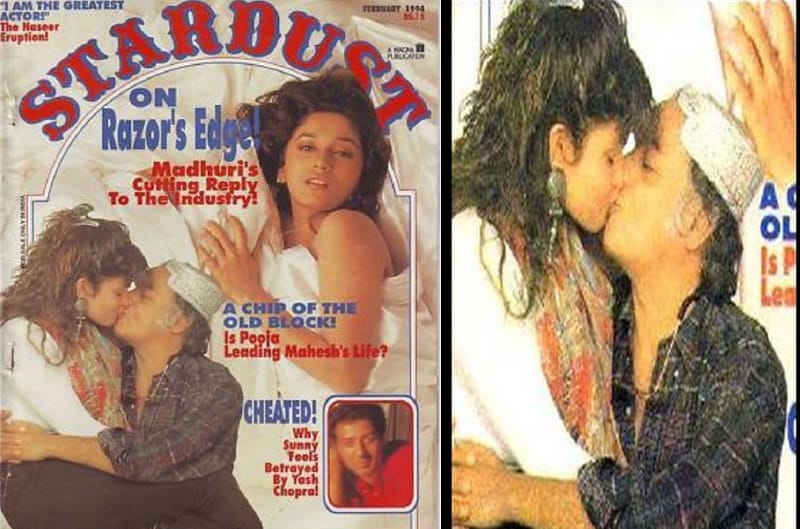
The 80s Filmfare magazine published one of the most talked about and controversial photo of Bollywood filmmaker Mahesh Bhatt, where he locked lips with his daughter Pooja Bhatt. The picture was on the cover of the magazine. It also had one statement published saying that had she not been his daughter, he would have loved to marry her. Shocked right? The headline on the Filmfare magazine said,
“If Pooja wasn’t my daughter, I’d have loved to marry her.”
Away from the limelight and lechery now, Mahesh Bhatt champions many causes in the industry and remains to be one of the most significant filmmakers of his age. So despite all his controversies, problems and scandals.
The Enduring Shadow of a Kiss: Revisiting the Mahesh Bhatt and Pooja Bhatt Magazine Cover Controversy
The landscape of Indian cinema is dotted with moments of bold filmmaking, unconventional narratives, and, inevitably, sensational controversies. Few incidents from the history of Bollywood have managed to capture the public imagination and spark furious debate for decades quite like the infamous magazine cover featuring filmmaker Mahesh Bhatt and his daughter, actress Pooja Bhatt.
More than a simple photograph, the image, and the subsequent statements made by the father-daughter duo, became a cultural flashpoint, forcing a national conversation about morality, artistic expression, and the often-blurred lines between a celebrity’s private and public life. Decades later, the controversy continues to be a defining, if painful, chapter in the public narrative of the Bhatt family.
The Photograph That Stopped a Nation
The photograph that triggered the national outrage was featured on the cover of the popular Bollywood-centric magazine, Stardust, in the early 1990s. The visual captured a moment that was highly unconventional for a father and daughter in the public eye in India: Mahesh Bhatt was photographed sitting with his daughter, Pooja Bhatt, who was seated on his lap, while the two shared a kiss on the lips.
In a society where public displays of physical affection between family members, particularly between adults of the opposite gender, are often reserved and constrained, the photograph immediately sparked a media storm. The intensity of the reaction went far beyond normal celebrity gossip, transforming into a moral and cultural debate.
The Shockwaves Across the Public Sphere
The publication of the image triggered widespread outrage and criticism that escalated daily. It was perceived by a significant section of the populace and media as a brazen transgression of traditional Indian cultural and moral boundaries, particularly the sanctity of the parent-child relationship.
The sheer volume and vitriol of the backlash eventually compelled the filmmaker to address the controversy directly. Instead of attempting to mollify the public, Mahesh Bhatt’s defensive remarks in a subsequent press conference only amplified the controversy to an unprecedented level.
The Statement That Fueled the Fire
The controversy was already raging when Mahesh Bhatt decided to hold a press conference to manage the public relations disaster. However, his attempt to defend the photograph and his relationship with his daughter backfired spectacularly.
It was at this press conference that he delivered the statement that would become one of Bollywood’s most quoted—and reviled—controversial remarks: “If Pooja had not been my daughter, I would have married her.”
This single, explosive line, spoken in a moment of emotional intensity, was interpreted by many as an admission of a deeply inappropriate, if not incestuous, attraction. The context of his statement was quickly overshadowed by its sensational nature, sending shockwaves across the country and adding dangerous fuel to an already inflamed debate.
The statement served multiple purposes in the narrative:
- A Confession of an Unconventional Bond: For Mahesh Bhatt, the controversial remark may have been a hyperbolic attempt to articulate the depth and possessiveness of his affection for his daughter, or an attempt to use shock value, a tactic he was known for, to dominate the narrative.
- A Confirmation of Public Fear: For the moral watchdogs and the outraged public, the statement confirmed their worst fears—that the image represented a breakdown of traditional family values and societal norms.
- An Unprecedented Media Event: It cemented the controversy’s place in Bollywood history, turning a single magazine cover into a decade-spanning cultural talking point.
Pooja Bhatt’s Defense: An ‘Absolutely Innocent’ Moment
Throughout the decades-long discussion of the incident, Pooja Bhatt has maintained a consistent and steadfast defence of the photograph and her relationship with her father. She has always framed the picture as a moment of “absolutely innocent” familial love and affection, which was brutally misrepresented by a sensationalist media and a judgemental public.
Her core arguments, reiterated in various interviews over the years, focused on two main points:
1. The Power of a ‘Frozen Moment’
Pooja Bhatt explained that a static image, a “frozen moment,” can be endlessly represented and misrepresented depending on the viewer’s lens. She likened the spontaneous kiss to the natural, innocent affection children show their parents, regardless of the child’s age.
She emphasized the enduring nature of her bond with her father, stating that even as an adult, she remains her father’s “10-pound child” in his eyes.
2. Criticism of Public Mindset
The actress-turned-filmmaker has repeatedly expressed her lack of regret for the photoshoot, asserting that she would not be compelled to defend a pure relationship. She famously pointed out the hypocrisy of the outrage: “If people can look at a father-daughter relationship from a twisted lens, they’re capable of anything. Then we talk about family values. What an incredible joke that is,” she remarked, essentially turning the criticism back onto the moral standards of the judgmental public.
The Personalities and Their Context
To fully understand the magnitude of the controversy, one must examine the public personas of Mahesh and Pooja Bhatt, who were known for pushing boundaries both on and off-screen.
Mahesh Bhatt: The Architect of Controversy
Mahesh Bhatt had already cultivated a reputation as “controversy’s favourite child.” A director known for making critically acclaimed, often semi-autobiographical films (Arth, Saaransh, Daddy) that tackled sensitive, unconventional, and dark themes, his public life mirrored the intensity of his cinema.
His public persona was marked by a blunt, philosophical, and often provocative style of speaking that made him a media magnet. The “marry her” comment, while shocking, was arguably consistent with his pattern of using extreme rhetoric to express powerful emotions or challenge societal conventions, even if it meant risking outrage.
Pooja Bhatt: The Bold and Unconventional Star
Pooja Bhatt debuted with her father’s film Daddy (1989) and quickly established herself as one of the most prominent, stylish, and “bold” actresses of the 1990s. Her career included commercial hits like Dil Hai Ke Manta Nahin and Sadak (both 1991), and she consistently took on unconventional roles that challenged stereotypes.
Her on-screen image was one of a fearless, free-spirited young woman. This pre-existing public image of “boldness” perhaps made the media and the public more receptive—and simultaneously more critical—of such a provocative photoshoot. She was already pushing the envelope in her career, and the cover photo was seen by many as an extension of this boundary-pushing nature.
The Legacy of the Infamous Cover
The Mahesh Bhatt-Pooja Bhatt controversy did not fade away; it simply entered the annals of Bollywood history as one of the most enduring and frequently referenced scandals.
- A Symbol of Media Sensationalism: The incident is often cited as a prime example of how celebrity-driven media in India can exploit an intimate, private moment, regardless of the context, to achieve maximum sensationalism and sales.
- Cultural Conversation Starter: The public debate surrounding the photo, though rooted in outrage, inadvertently raised questions about the changing nature of familial relationships, generational differences in expressing affection, and the puritanical standards often imposed on public figures in India.
- Familial Resilience: Despite the backlash, the family has maintained that the controversy did not weaken their bond. Pooja Bhatt’s brother, Rahul Bhatt, later remarked that growing up in a film family made them “immune” to such controversies, as they knew the truth of their relationship “since childhood.” Mahesh Bhatt himself later reflected that such hardships under the “arc lights” served only to bring out the “gold” in a person, strengthening their connection.
The controversial kiss, captured decades ago, remains a potent symbol of the collision between private life and public scrutiny in the world of Indian cinema. While the Bhatt family members have consistently dismissed the outrage as a twisted misinterpretation, the event itself continues to define a specific, tumultuous moment in the history of Bollywood’s relationship with Indian society.
AISEO Friendly FAQs
Q1: What was the controversy involving Mahesh Bhatt and Pooja Bhatt?
A: The controversy centered around a photograph published on the cover of the Stardust magazine in the early 1990s, which showed filmmaker Mahesh Bhatt kissing his daughter, actress Pooja Bhatt, on the lips while she sat on his lap. The image and the subsequent statement by Mahesh Bhatt caused widespread outrage and a major cultural debate in India.
Q2: What famous statement did Mahesh Bhatt make regarding Pooja Bhatt?
A: When addressing the controversy in a press conference, Mahesh Bhatt made the highly provocative statement, “If Pooja had not been my daughter, I would have married her.” This remark was widely criticized and significantly intensified the public outrage surrounding the photo.
Q3: How did Pooja Bhatt defend the controversial photograph?
A: Pooja Bhatt consistently defended the photograph, calling the moment captured “absolutely innocent” and a reflection of her deep, protective bond with her father. She has stated that she does not regret the photoshoot and criticized those who chose to interpret the father-daughter relationship through a “twisted lens.”
Q4: When did the Mahesh Bhatt and Pooja Bhatt kiss controversy happen?
A: The infamous photo was featured on the cover of Stardust magazine around the early 1990s (sometimes cited as 1990 or 1991). The controversy immediately erupted upon the magazine’s release.
Q5: What was the broader context of Mahesh Bhatt’s public image at the time?
A: Mahesh Bhatt was already known in the film industry for his outspoken nature and his status as “controversy’s favourite child.” As a director who made intense, often autobiographical films, his public persona was that of a blunt, unconventional figure who frequently challenged societal norms, making his provocative statement less surprising to those familiar with his history.

This Post Has 0 Comments