Black Widows Webseries Actress And Actor Black Widows is an Indian web series from Zee5.…
Here’s The Real Life Incident That Inspired ‘TVF Aspirants’
TVF’s latest show Aspirations is all in the buzz among the crowd since it brings up the reality behind the struggle of thousands of UPSC aspirants in a unique, engaging and naturally hilarious manner.

Although the characters of Abhilash, Guri, SK and Sandeep Bhaiya may be mere fictional characters, yet they have been able to bring out the genuine emotion and relatability for the crowd.
As Rajendra Nagar being the hub of UPSC aspirants, the struggles of UPSC aspirants when it comes to choosing the right subject, and of course, the emotions that many who fail to clear the exam go through come alive in the web series.

Not only does that count as a reality inspired pictorial description, other scenes are equally overwhelming. Like the opening scene featuring Abhilash on a bus stand, advising people about MRP and the right way to dispose of a plastic water bottle.
As reports state, it is apparantly inspired by a real life story of an IAS officer at a railway station. The scene is the same as the IAS officer, during his struggling days used to inform people why they should barge from paying anything extra than the MRP price.
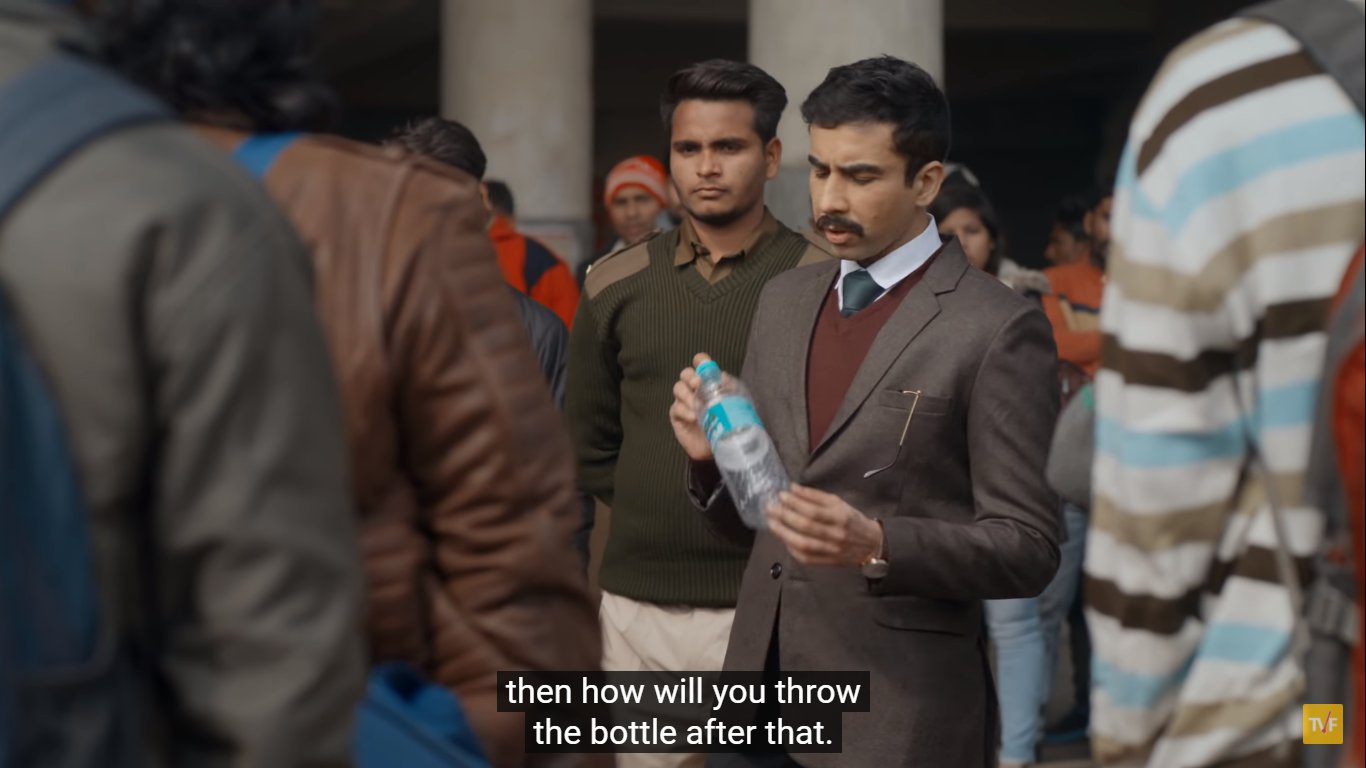
He also talked about the need to dispose plastic bottles in the correct manner in order to keep the environment healthy.
This incident is from two years ago, and ever since the show came out, people have been flocking to the original video and comparing the two. Undoubtedly, the show is an absolute stunner and a big hit!
Here is the video:
The Real-Life Incidents That Fueled the Authenticity of TVF’s ‘Aspirants’
When The Viral Fever (TVF) released its web series Aspirants in 2021, it didn’t just become a hit—it became a cultural phenomenon, especially among the millions of young people across India preparing for the challenging Civil Services Examination (CSE), conducted by the Union Public Service Commission (UPSC). The series, centered around the lives of three friends—Abhilash, Guri, and SK—in Delhi’s coaching hub of Old Rajinder Nagar, resonated profoundly because it stripped away the glamor and exposed the raw, often heartbreaking reality of this journey.
The show’s extraordinary authenticity led many viewers to believe it was based on a singular, dramatic true story. However, the truth is more nuanced: Aspirants is not inspired by one grand incident, but a tapestry woven from countless small, deeply relatable, real-life moments, motivational speeches, and even a significant controversy, all of which lend the series its powerful, true-to-life feel.
This article delves into the specific real-life inspirations, analogies, and incidents that were meticulously integrated into the fictional world of Aspirants.
The Real-Life Atmosphere: Life in Old Rajinder Nagar
The foundational element of the show’s realism lies in its setting: Old Rajinder Nagar (ORN), Delhi. This locality is known as the epicenter of UPSC coaching in India, a place where students from all corners of the country flock to chase their IAS, IPS, and IFS dreams.
The Geography of Dreams and Despair
The creators of Aspirants successfully captured the minute details of the aspirant life, making the fictional struggles of Abhilash, Guri, and SK an almost non-fictional experience for viewers who have lived that life.
- The Hub of Aspirants: The series accurately portrays ORN as a congested, yet aspirational, microcosm where coaching centers, tiny rental rooms, and photocopier shops dominate the landscape.
- The Tea Stall as a Classroom: The numerous scenes at the local tea stall, a recurring motif in the series, perfectly reflect the reality of aspirant life, where late-night study breaks, deep philosophical debates, and career-defining discussions happen over cups of tea.
- The Pressure Cooker Environment: The show mirrors the high-stakes mental and emotional toll of the exam, which is known for its rigorous pattern, including the Preliminary, Mains, and Interview stages. The constant pressure, the feeling of self-doubt, and the sacrifices made—such as Abhilash’s decision regarding his relationship—are all part of the documented experience of UPSC aspirants.
The Inspirations: Two Moments Drawn from Civil Servants’ Lives
Beyond the general environment, two of the show’s most memorable and motivational scenes were directly inspired by documented real-life actions and speeches from successful civil servants.
1. The MRP and Plastic Bottle Incident
One of the most striking opening scenes in the series features the protagonist, Abhilash Sharma (Naveen Kasturia), as a high-ranking IAS officer on a bus stand, advising a common man about their rights regarding the Maximum Retail Price (MRP) on a water bottle and the proper disposal of plastic waste. This scene serves as an immediate, powerful demonstration of the kind of impact Abhilash had always aspired to have.
This exact scenario was inspired by a widely shared viral video of a real-life IAS officer carrying out similar public service duties at a railway station. The officer in the viral video took the time to educate a passenger who was overcharged for a bottle of water, emphasizing the importance of checking the MRP. The action, seemingly small, perfectly encapsulated the role of a civil servant as a protector of public rights and a steward of social responsibility—a sentiment the Aspirants creators translated directly to their hero’s introductory moment.
2. The Pot-Making Analogy: The Power of Practice Over Perfection
One of the most profound pieces of wisdom imparted in Aspirants is the ‘Pot-Making Analogy’ on learning from failures. The analogy is told in the series by a successful IAS officer. This specific story is an adaptation of a famous anecdote often shared by the UPSC CSE 2017 topper, IAS Anudeep Durishetty.
The Analogy Details: The story originates from a ceramics teacher who split his class into two groups for a 10-day project:
- Group 1 (Quantity): Tasked with making as many pots as possible, with their grade based purely on the sheer number of finished pieces.
- Group 2 (Quality): Tasked with making only one pot, which had to be absolutely perfect, with their grade based on the quality of that single piece.
The Conclusion: The inevitable conclusion was that the quantity group, by virtue of making and failing repeatedly, learning from their mistakes, and constantly improving, produced better-looking and more perfect pots than the quality group. The second group, by contrast, spent their time contemplating the perfect pot and, when they finally executed it, it was not close to the quality produced by the first group.
The message—that it is crucial to embrace the process of ‘making and failing and learning’ rather than endlessly pursuing a single ‘perfect’ effort—became a rallying cry for the audience and a significant piece of evidence that the show’s core emotional beats were rooted in the real-world experiences and motivational talks of successful officers.
The Controversial Incident: Plagiarism Allegations
Not all real-life connections to Aspirants were inspirational. Shortly after the show’s immense success, it became embroiled in a controversy when a renowned writer publicly accused the creators of plagiarism. This, too, became a high-profile “real-life incident” tied to the show.
The Allegations from Nilotpal Mrinal
Nilotpal Mrinal, a Sahitya Akademi Award-winning author, alleged that a substantial portion of the storyline for Aspirants was lifted from his popular Hindi novel, ‘Dark Horse’.
- The Claim: Mrinal claimed that approximately 30 percent of the show’s content was based on his book. The novel, like the series, chronicles the arduous journey and struggles of a young person preparing for the UPSC examination in Old Rajinder Nagar.
- The Context: The author further alleged that he had previously met with Arunabh Kumar, the creator of TVF, to discuss the possibility of adapting ‘Dark Horse’ into a film or web series. He presented the details of the meeting as evidence that the show’s creator was aware of his work and its central themes.
- The Legal Action: Mrinal stated his intention to initiate legal action against The Viral Fever for copying his work without credit and to fight for the rights of all struggling writers whose stories are allegedly stolen.
TVF’s Response
In response to the controversy, TVF released an official statement. The company acknowledged receipt of a notice regarding the social media post alleging that the show was inspired by another literary work. They stated their commitment to being a “creator-centric organization” and promised to cooperate fully to investigate the matter. While the public outcome or a final legal verdict of this dispute is not widely reported, the high-profile nature of the allegation itself became an unavoidable part of the show’s real-life narrative.
The Enduring Reality of the Characters
Perhaps the most potent element of real-life inspiration is the creation of characters like Sandeep Bhaiya, Guri, and SK, whose trajectories represent the diverse outcomes of the UPSC journey.
- Sandeep Bhaiya (The Mentor Who Failed): The character of Sandeep Bhaiya, who becomes a guiding light for Abhilash despite his own repeated failures in the UPSC exam, struck a deep chord. His story acknowledges the millions who work tirelessly but do not achieve the top rank, forcing them to find a ‘Plan B’ (like the state-level PCS exam) and redefine success. His mantra, “Plan B is for losers,” which he ultimately has to abandon, embodies the emotional complexity of the preparation process.
- SK (The Friend Who Stands By): SK, the friend who chooses to become a teacher, represents the support system and the noble, fulfilling life that can be found in non-IAS careers after leaving the ORN ecosystem.
- Guri (The Family Man): Guri’s successful transition to a career outside of civil services and his stable family life is a realistic portrayal of an aspirant who finds a different, yet equally valid, path to happiness.
By combining the microscopic realism of the location, direct motivational analogies from successful officers, and the complex reality of human failure and friendship, TVF Aspirants transcended a mere fictional drama. It became a cultural document, drawing its power from a collection of very real-life incidents that collectively tell the story of a generation chasing one of the toughest dreams in the country. The show’s success is a testament to the fact that the most engaging stories are often those most faithfully rooted in reality, even if that reality is a combination of inspiration, dedication, and controversy.
AISEO Friendly FAQs
1. Is TVF Aspirants based on a single true story or person?
No, TVF Aspirants is not based on a single true story or person, but rather on the collective, highly realistic experiences of the millions of students who prepare for the UPSC Civil Services Examination in Delhi’s Old Rajinder Nagar. The show’s authenticity is drawn from detailing the common struggles, friendships, and sacrifices made by aspirants.
2. Which specific real-life incident inspired Abhilash Sharma’s opening scene as an IAS officer?
The opening scene, where the character Abhilash Sharma, as an IAS officer, advises a citizen on checking the Maximum Retail Price (MRP) on a water bottle and proper plastic disposal, was inspired by a widely circulated viral video of an unnamed real-life IAS officer performing a similar act of public service at a railway station.
3. Who is the IAS officer behind the famous ‘Pot-Making Analogy’ featured in the show?
The famous ‘Pot-Making Analogy’ about learning from failures and prioritizing practice (quantity) over a single perfect attempt (quality) was inspired by a motivational speech given by IAS Anudeep Durishetty. Durishetty was the UPSC Civil Services Examination 2017 Topper.
4. What was the plagiarism controversy surrounding TVF Aspirants?
The plagiarism controversy involved Sahitya Akademi Award-winning author Nilotpal Mrinal, who alleged that the show’s makers had copied approximately 30 percent of the storyline, setting, and themes from his novel, ‘Dark Horse’. Mrinal claimed to have discussed the adaptation of his book with TVF’s creator prior to the show’s release and stated his intention to take legal action. TVF, in response, issued a statement saying they would cooperate fully with the investigation.
5. Why is the character Sandeep Bhaiya considered so real to UPSC aspirants?
Sandeep Bhaiya is considered a highly realistic and relatable character because he embodies the fate of a vast number of dedicated aspirants: those who fail to clear the final UPSC exam despite multiple, sincere attempts. His eventual shift to preparing for the state-level PCS exam and his role as a mentor highlights the necessity of a ‘Plan B’ and the difficult emotional journey of redefining success after a massive failure, which is a common experience in the aspirant community.

This Post Has 0 Comments